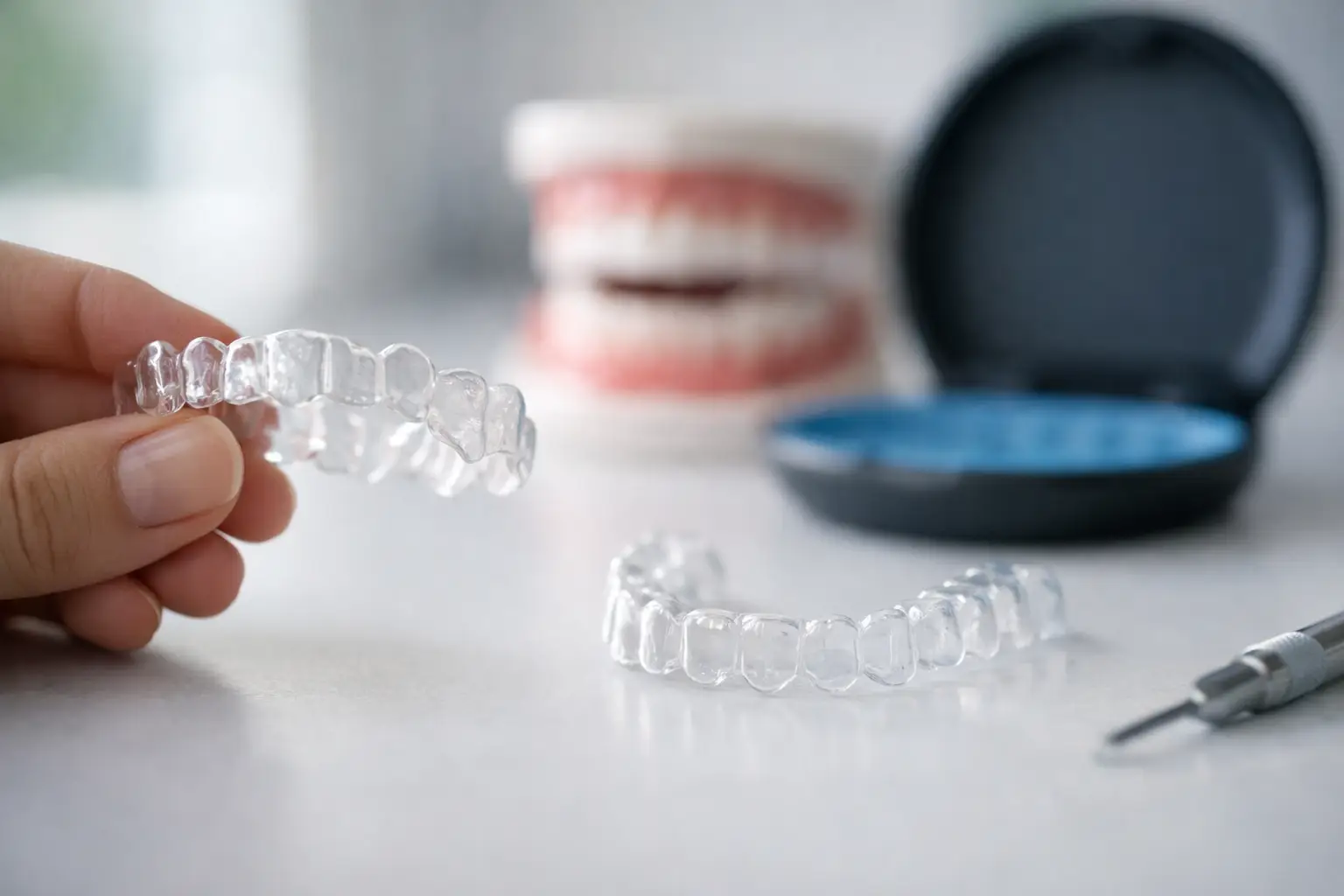

A patient says, "This tray fit yesterday, and today it will not seat in the molars." That moment matters. When asking why aligners stop fitting, the real issue is rarely the plastic itself. More often, it is a sign that tooth movement, force expression, wear behavior, or jaw progression has fallen out of sync with the treatment plan.
For clinicians, poor aligner fit is not just an inconvenience. It is an early warning signal that predictability is slipping. For patients, it can feel sudden and confusing. But aligners do not usually stop fitting without a reason. The underlying cause may be mechanical, biologic, behavioral, or workflow-related, and the right response depends on identifying which one is driving the loss of fit.


Why aligners stop fitting in real cases
In most cases, aligners stop fitting because teeth did not move as expected between stages. The tray was manufactured to engage a planned tooth position. If one or more teeth lag, rotate incompletely, intrude inconsistently, or express torque less than projected, the next aligner loses full seating. What patients describe as a "tight tray" is often a mismatch between digital staging and actual biologic response. That mismatch becomes more obvious at the posterior. Many clinicians see a common pattern - anterior seating appears acceptable, but the tray lifts in the premolar or molar region. Sometimes this is caused by incomplete incisor engagement creating a fulcrum effect. In other cases, posterior eruption, occlusal interferences, or uneven arch progression are involved. The visual symptom is simple. The reason behind it usually is not. Biology is part of the equation. Some teeth move efficiently with standard aligner force systems, while others resist. Cylindrical teeth, short clinical crowns, heavily restored surfaces, and roots with challenging anatomy can all change force response. Attachments may be present and still underperform if the programmed movement exceeds what the tooth can predictably express in that interval.The most common causes behind loss of fit
Noncompliance remains one of the biggest factors, but it is not the only one. Patients may report full-time wear while actually underperforming by several hours each day. Even modest reductions in wear time compound quickly, especially in stages with more rotation, extrusion, or torque. The tray then becomes a test of compliance and a reminder that aligner therapy only works when force is delivered consistently. But even highly compliant patients can lose fit. Poor tracking often appears when movement sequencing is too ambitious for the anatomy or the force system. Rotations of round teeth, significant root movement, vertical correction, and expansion combined with crowding relief can all create staging friction. The digital plan may be technically possible, yet clinically inefficient if too much is asked of the tray at once. Attachment issues matter more than many patients realize. If an attachment fractures, debonds, or was never fully expressed in the aligner, force delivery changes immediately. That can lead to partial seating, especially in movements that depend on attachment geometry for control. Small discrepancies in composite shape can create larger discrepancies in movement over multiple stages. Interproximal reduction can also influence fit. If IPR was planned but not completed, or completed differently than prescribed, the aligner may no longer correspond to the available space. A fraction of a millimeter sounds minor on paper. Across several contacts, it can be enough to affect staging and tray engagement. Then there is timing. Advancing too quickly can cause the next aligner to seat poorly because the previous stage was not fully expressed. Advancing too slowly can also create problems in some cases, particularly when trays distort from prolonged wear or lose retentive precision. The answer is not simply "wear longer" or "switch sooner." It is matching stage progression to actual tracking.Why aligners stop fitting even with good compliance
This is where clinicians need a more precise explanation. When patients wear trays as directed and still lose fit, the likely issue is not motivation. It is treatment control. Certain movements are inherently less predictable with aligners alone. Extrusion, root torque, derotation of canines and premolars, and coordinated bilateral progression often demand more than passive tray change mechanics. If upper and lower arches are not progressing in a synchronized way, occlusal contacts can interfere with seating and create a cascade of tracking loss. One arch may appear to be the problem when the true issue is interarch disharmony. This is also why posterior fit complaints should not be dismissed as routine. In many cases, they reflect force imbalance or unsynchronized treatment progression rather than simple tray stiffness. Once the arches stop working in coordination, seating gets harder, refinement risk rises, and treatment duration starts to drift.What clinicians should evaluate first
The first step is to determine whether the aligner is inaccurate or the movement is incomplete. Most of the time, the movement is incomplete. Check for attachment integrity, compare current tooth position to the previous stage, and assess whether the tray fails at one tooth, one segment, or across the arch. Localized discrepancy suggests a movement-specific problem. Global loss of fit suggests broader tracking failure, poor wear, or an issue with tray deformation. Look closely at posterior occlusion and interarch coordination. If the patient has progressed asymmetrically, especially in cases involving bite correction or expansion, the tray may be fighting the bite. That creates seating resistance the patient cannot overcome simply by chewing on aligner seaters. Review wear history, but do not stop there. Ask how the trays are being inserted, whether the patient removes them frequently for snacks or coffee, and whether any recent travel, illness, or schedule disruption reduced wear consistency. Then compare that history with the complexity of the stage. A patient who can get away with 20 hours on a low-demand stage may lose tracking fast on a more force-sensitive one.The clinical cost of ignoring poor fit
When a tray does not fit and treatment continues anyway, the problem rarely stays small. A single lagging tooth can compromise the next two or three stages. Soon the case requires additional attachments, midcourse correction, rescanning, or refinement. That adds chair time, extends treatment, and weakens patient confidence. The bigger concern is predictability. Aligner therapy performs best when force application, sequencing, and arch coordination remain controlled from stage to stage. Once control is lost, every subsequent aligner becomes less reliable. The result is slower treatment disguised as continued progress.How better control improves aligner seating
Better seating is not just a comfort win. It is a treatment control win. When force application is more efficient and upper and lower jaws progress in a coordinated way, trays fit more consistently and planned movements express with fewer interruptions. That is why many clinicians are shifting from a tray-only mindset to an enhancement mindset. The question is no longer whether the aligner can theoretically produce the movement. The question is whether the case has enough control built in to make that movement happen on schedule. A solution-oriented approach may include revising staging, improving attachment strategy, confirming IPR execution, and using adjunctive mechanics that support more synchronized progress. In workflows focused on acceleration and predictability, appliances such as SyncSplint can help improve aligner seating and force expression while supporting better coordination between arches. The practical value is straightforward - fewer fit failures, more consistent tracking, and less treatment drift.What patients should do when aligners stop fitting
Patients should not force a tray that clearly does not seat. They also should not jump ahead to the next aligner hoping the problem will solve itself. If a tray suddenly stops fitting, the safest move is to return to the last properly fitting tray if instructed by the doctor and contact the office promptly. From the patient side, honesty helps more than perfection. If wear time dropped, say so. If an attachment came off, mention it. If the tray felt wrong from the first day, that detail matters. The faster the cause is identified, the easier it is to recover tracking without losing momentum. Aligners are precise because the treatment is staged precisely. When that precision breaks, the fit tells the story early. For clinicians and patients alike, the goal is not just getting the next tray on. It is restoring the control that keeps treatment moving faster, cleaner, and more predictably from one stage to the next.