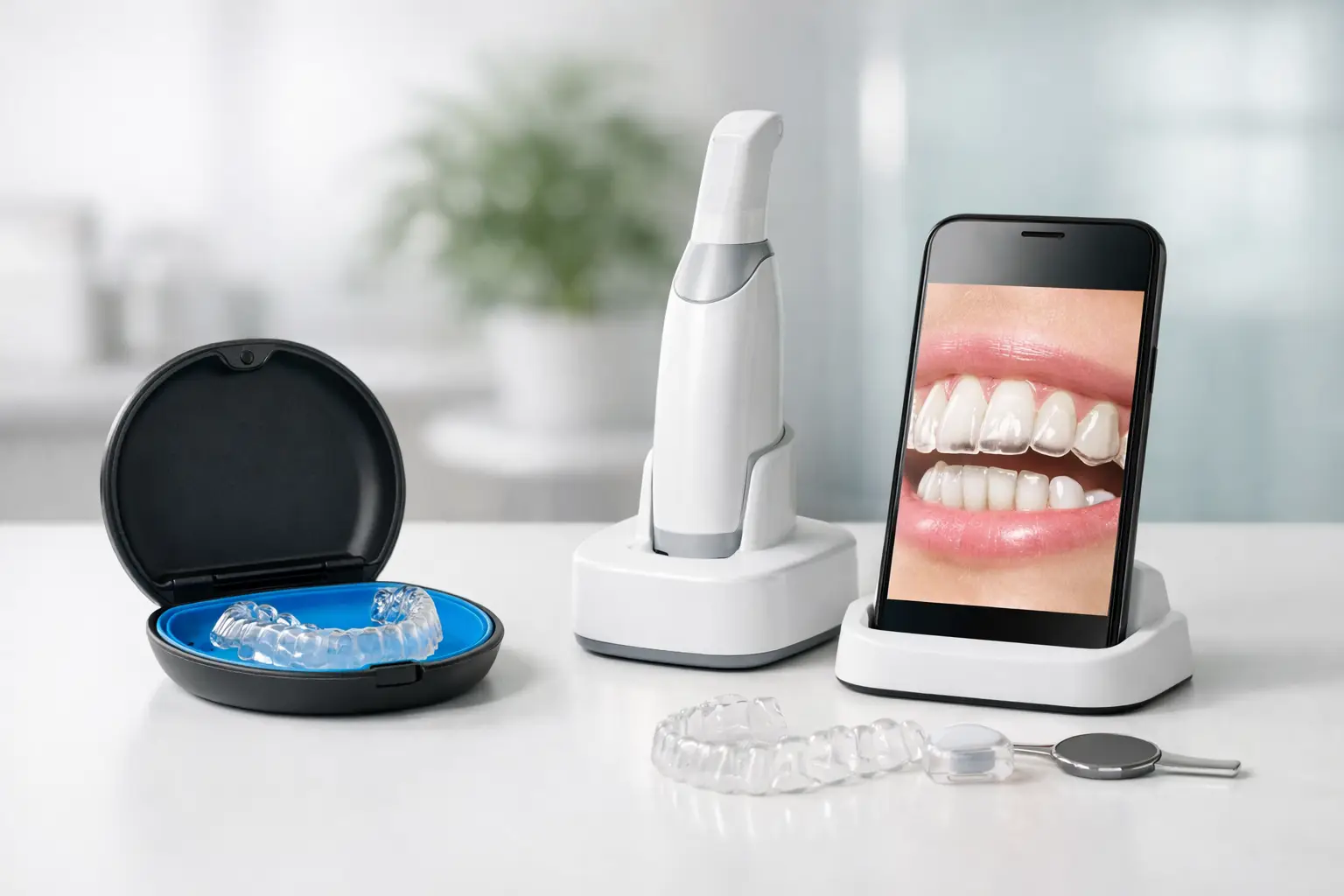

A case looks perfect on the setup, but by tray six the aligners stop seating cleanly, the bite drifts, and refinements start to feel inevitable. That gap between digital planning and clinical reality is exactly where an appliance for clear aligner tracking becomes valuable. For practices that want tighter control over fit, force delivery, and treatment timing, tracking is not a minor detail - it is the mechanism that protects outcomes.
Clear aligner therapy has expanded because patients want esthetics and convenience, and because clinicians can now treat a wider range of malocclusions with digital precision. But precision on screen does not guarantee precision in the mouth. Tracking can break down for several reasons: incomplete seating, biologic lag, inconsistent wear, competing occlusal forces, or upper and lower arches progressing at different rates. Once that happens, every planned movement becomes less reliable.


What an appliance for clear aligner tracking actually does
An appliance for clear aligner tracking is designed to support the aligner system rather than replace it. Its role is to help the trays seat more completely, maintain better engagement with programmed tooth movements, and reduce the mismatch between intended and actual progression. In practical terms, that means improving the conditions under which aligners can express force effectively. For clinicians, the key question is not whether tracking matters. It does. The real question is how to maintain it consistently across different case types and different aligner brands without rebuilding the entire workflow. That is why adjunctive appliances are getting more attention. They add a control layer to treatment without forcing a practice to abandon its preferred aligner manufacturer. This matters even more in cases where jaw coordination is part of the treatment challenge. If the upper and lower arches are not progressing in sync, tracking issues can compound quickly. One arch may appear on schedule while the other lags, creating fit discrepancies, bite changes, and added chair time. A well-designed adjunct can help synchronize progression and stabilize the path forward.Why clear aligner tracking fails in real cases
Most tracking failures are not caused by one dramatic mistake. They are usually the result of small deviations accumulating over time. A tray that is not fully seated at delivery may still look acceptable, but partial engagement can reduce the efficiency of the programmed movement. Over a series of trays, that inefficiency becomes visible. Biology is another variable. Some patients respond quickly, while others need more time for the same level of movement. Even compliant patients can lag behind the digital sequence if the force system is not being expressed cleanly. Add inconsistent wear or poor seating habits, and the treatment can drift from the original plan. There is also a mechanical issue that clinicians know well: aligners are only as effective as their fit. If the tray is not intimate to the dentition, force application becomes less controlled. Rotations, extrusion mechanics, and difficult root movements are especially vulnerable. What starts as a minor seating problem can turn into a predictability problem.The clinical value of an appliance for clear aligner tracking
The right appliance for clear aligner tracking improves more than tray fit. It supports treatment acceleration, sharper force application, and better control over case progression. That combination matters because speed without control creates risk, and control without efficiency creates friction for both practice and patient. When an appliance improves aligner seating, it can help the tray engage more fully with the tooth anatomy and programmed attachments. That improves the consistency of force transfer. Better force consistency can reduce the chance of delayed expression and lower the likelihood of falling off track between appointments. Another major benefit is predictability. Practices are under pressure to deliver aligner treatment that feels streamlined, not constantly interrupted by rescue protocols. Every unplanned refinement affects scheduling, case profitability, and patient confidence. Tracking support can reduce those disruptions by improving the reliability of each stage. For patients, the benefit is easy to understand even if the mechanics are technical. Better tracking often means fewer setbacks, less uncertainty, and a clearer sense that treatment is actually moving forward. That is a strong advantage in a market where expectations for speed and convenience are high.What to look for in an appliance for clear aligner tracking
Not every adjunctive device delivers the same clinical value. The best option should integrate with existing aligner protocols, not complicate them. If a device demands a completely separate system, adds unnecessary steps, or limits brand flexibility, adoption becomes harder than it needs to be. Compatibility is the first requirement. Orthodontists and dentists need an appliance that works with major aligner systems so they can preserve their current planning and vendor relationships. That flexibility supports adoption across a wider range of cases and avoids operational disruption. The next factor is functional performance. A useful tracking appliance should help with aligner seating, support synchronized jaw progress, and contribute to more efficient tooth movement. Those benefits are connected. If the appliance helps aligners seat more accurately while keeping upper and lower progression coordinated, treatment becomes easier to manage. Ease of incorporation also matters. Clinicians do not need another idea. They need something that fits into digital workflows, model-based fabrication, and normal appointment pacing. The stronger the integration, the more likely the appliance is to be used consistently and correctly.Why jaw synchronization changes the conversation
One of the most overlooked causes of aligner inefficiency is unsynchronized upper and lower arch progression. In many cases, clinicians are not just moving teeth. They are managing an interarch relationship that has to evolve in a coordinated way. If one arch falls behind, the bite can destabilize and the aligners can become harder to seat accurately. That is where a more advanced appliance strategy offers a distinct advantage. An appliance that supports both tracking and jaw synchronization addresses a deeper source of treatment disruption. Instead of reacting after discrepancies appear, the clinician can guide progression more proactively. This is where SyncSplint stands out as a future-focused solution. It is designed to work alongside established clear aligner systems, helping accelerate movement, improve force application, and synchronize upper and lower jaw treatment progress. For providers who want more control without switching aligner brands, that is a meaningful shift from workaround thinking to system-level performance.Who benefits most from a tracking appliance
Not every case needs the same level of intervention, and that nuance matters. Simple alignment cases with highly compliant patients may track well with standard protocols alone. But many real-world cases are not that simple. Adults with complex bite relationships, teens with inconsistent wear, and patients showing early signs of lag can all benefit from additional tracking support. Clinicians managing higher case volume may also see operational value quickly. Even a modest reduction in refinements, emergency visits for poor fit, or delays in progression can improve efficiency across the practice. The payoff is not only clinical. It is financial and logistical. There is a patient communication advantage too. When providers can explain that the appliance is being used to improve fit, control treatment progress, and support faster completion, acceptance becomes easier. Patients do not need a lecture on biomechanics. They need confidence that the treatment plan is being actively optimized.Trade-offs and realistic expectations
An appliance for clear aligner tracking is not a shortcut around diagnosis, planning, or compliance. If the setup is flawed or the patient does not wear the aligners, no adjunct can fully compensate. Tracking appliances work best when they are part of a disciplined clinical protocol. It also depends on case selection. Some cases may benefit more from targeted use during specific stages rather than from start to finish. Others may justify full integration from the beginning because the risk of drift is higher. The point is not to treat every patient identically. The point is to use better tools where they produce meaningful control. The strongest clinical approach is to view tracking support as an enhancer of aligner biomechanics, not as a rescue device after failure. That mindset changes how treatment is planned and how predictability is protected. Clear aligner therapy keeps advancing, but the practices that lead will be the ones that close the gap between digital intention and clinical execution. If you want faster cases, stronger tray fit, and more dependable arch coordination, the right appliance for clear aligner tracking is not an accessory. It is a smarter standard.