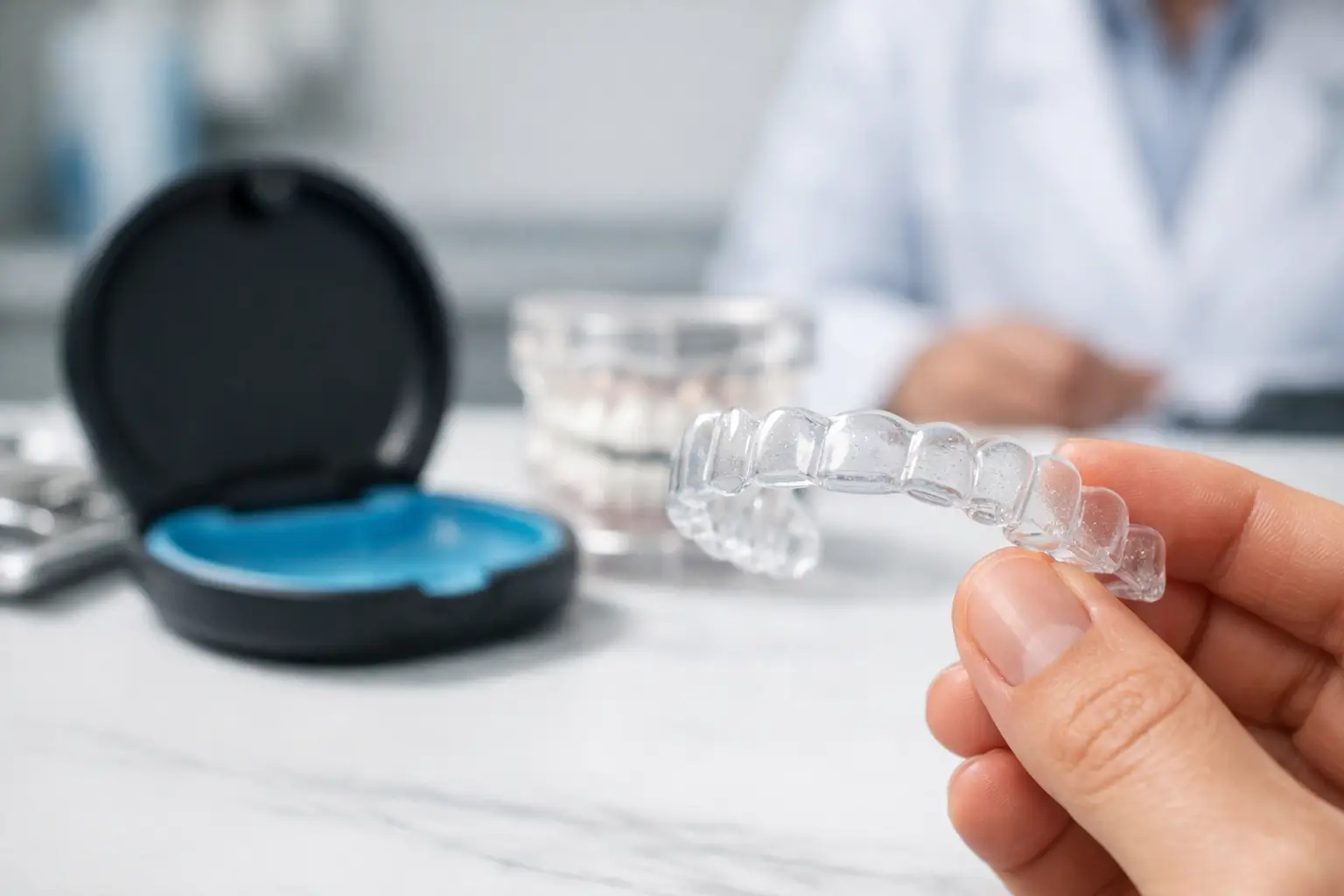

A case looks perfect in the digital setup. Then week eight arrives, the lower arch is trailing, a lateral is not expressing, and the patient says they have been wearing trays exactly as prescribed. That gap between plan and biology is where clear aligner case control is won or lost.
For clinicians, case control is not just about attachment design or staging strategy. It is about maintaining consistent force expression across both arches, keeping aligners fully seated, and reducing the small timing failures that compound into refinements, delays, and compromised predictability. If the goal is faster, more controlled treatment without changing aligner systems, the real question is simple: what gives you more control once treatment is already in motion?


What clear aligner case control really means
In practice, clear aligner case control means the teeth are moving at the pace and in the pattern intended by the setup, with both arches progressing in a coordinated way. It is a clinical performance issue, not a marketing phrase. When control is strong, aligners seat well, tracking remains stable, interarch timing stays synchronized, and the patient reaches each stage without avoidable drift. When control weakens, the signs usually appear early. Posterior lift increases, seating becomes inconsistent, one arch advances faster than the other, and planned movements stop expressing cleanly. A single lagging segment may seem manageable, but in longer treatments those small failures often trigger a chain reaction - more monitoring, more troubleshooting, more midcourse corrections, and more refinement trays. That is the part many discussions miss. Clear aligners do not fail all at once. Case control usually erodes gradually through force loss, fit issues, and unsynchronized progress.Why some aligner cases lose control
Biomechanics is only part of the story. Even a strong digital plan depends on what happens in the mouth every day. Tooth movement is affected by seating, compliance, anatomy, occlusion, attachment engagement, and how consistently force is delivered over time. The plan may be precise, but the oral environment is variable. One common issue is incomplete aligner seating. If the tray is not fully adapted, force expression drops immediately. The aligner may still look acceptable to the patient, but clinically it is underperforming. That matters most in rotations, extrusion, torque control, and more complex staged movements where precision is less forgiving. Another issue is unequal arch progression. Upper and lower arches rarely behave identically, yet many protocols assume they will stay aligned if tray changes are followed. In reality, one arch can respond faster while the other lags. That mismatch creates downstream problems in occlusion, fit, and staging efficiency. Then there is treatment fatigue. The longer a case runs, the more likely wear quality changes. Not always because the patient becomes noncompliant, but because enthusiasm fades, fit issues become normalized, and minor delays stop feeling urgent. Better case control often comes from reducing these friction points before they become visible problems.The three levers that improve control
If you want more predictable aligner performance, focus on three levers: force application, aligner seating, and jaw synchronization. These are not separate concerns. They influence one another throughout treatment. Force application has to be consistent enough to keep movement active between visits. If forces decay too quickly or are not expressed efficiently through the tray, the planned movement slows or stalls. This is where a case that looked straightforward starts requiring extra time. Aligner seating is the delivery mechanism for that force. A well-designed treatment plan still depends on intimate tray adaptation. Better seating improves tracking, makes attachments work harder, and reduces the gap between programmed movement and clinical reality. Jaw synchronization matters because treatment success is not measured arch by arch. If one jaw moves ahead while the other falls behind, the case becomes harder to manage even if each arch appears acceptable in isolation. Coordinated progression improves occlusal development and makes staging decisions more reliable.Clear aligner case control and mid-treatment predictability
The most useful test of clear aligner case control is not how a case starts. It is how it behaves after the early easy movements are done. Mid-treatment is where control either proves itself or starts to break down. At that point, clinicians are no longer evaluating the promise of the setup. They are evaluating expression. Are the trays still seating fully? Are the planned contacts developing on time? Are the upper and lower arches progressing together? Are difficult movements still tracking, or are they being carried forward unresolved? This is why systems that improve daily force delivery and seating can have outsized value. They do not just help with one appointment. They stabilize the treatment environment between appointments, where most loss of control actually occurs. A practical enhancement strategy does not need to replace the primary aligner brand. In many practices, the smartest move is adding a compatible appliance that strengthens how the aligners perform clinically. That preserves the existing workflow while improving case execution. For offices that want tighter control without rebuilding their protocol, that is a meaningful advantage.Where adjunctive appliances change the equation
Adjunctive appliances are most effective when they solve a specific treatment weakness rather than adding complexity for its own sake. In aligner therapy, the recurring weaknesses are familiar: inconsistent seating, insufficient force expression, slower movement than planned, and upper-lower timing mismatch. An appliance designed to work alongside clear aligners can address those issues directly if it improves tray adaptation and supports more synchronized movement. That is not a cosmetic add-on. It is a mechanical intervention aimed at predictability. This approach is especially relevant in cases where refinement risk is high. Mild to moderate cases may look simple on paper, yet still lose efficiency if the patient struggles with seating or if one arch consistently trails. More complex cases, of course, magnify the same problem. Better control early often means fewer compromises later. SyncSplint was built around that reality. Its role is not to replace existing aligner systems, but to enhance them by accelerating tooth movement, improving force application, and helping synchronize upper and lower jaw progress. For clinicians, that means a tighter link between the digital plan and what actually happens in the mouth.How to evaluate case control in your own workflow
The right question is not whether a case finished eventually. The right question is how much intervention it required to stay on course. If a significant share of cases need extra trays, repeated seating corrections, or schedule extensions, the issue may not be case selection alone. It may be control. Start by reviewing where loss of predictability appears most often in your workflow. Some practices see recurring lag in lower anterior expression. Others notice unilateral seating issues, posterior open bite development, or repeated arch desynchronization. These patterns matter because they point to mechanical weaknesses, not random bad luck. Then look at the burden on chair time. More monitoring, more troubleshooting, and more refinement planning all reduce the efficiency gains aligners are supposed to deliver. Stronger case control is valuable not only because outcomes improve, but because the workflow becomes easier to manage. Finally, consider patient experience. Patients rarely describe treatment in biomechanical terms. They describe whether trays fit, whether progress feels steady, and whether treatment is taking longer than expected. Better control improves confidence because the treatment feels coordinated and intentional.Better control without changing everything
There is a reason many clinicians hesitate to change aligner systems even when they want better results. Rebuilding protocols is disruptive. Staff retraining takes time. Vendor changes affect planning habits, communication, and inventory. Most practices do not want a new ecosystem. They want more performance from the one they already trust. That is why compatibility matters. An enhancement layer that works across major aligner systems is often more practical than a full platform change. It lets the practice improve treatment speed and predictability while preserving the planning environment already in place. That matters even more in growing practices, where efficiency has to scale. Better case control reduces drag on the schedule, lowers refinement volume, and supports a more consistent standard of care across providers. It is a clinical gain, but it is also an operational one. Clear aligner therapy will always involve biological variability. No appliance can erase that. But better force expression, better seating, and better jaw synchronization can narrow the gap between digital intention and clinical reality. That is where case control becomes more than a goal. It becomes a system. The practices that lead in aligner therapy are not simply choosing cases carefully. They are building protocols that hold treatment on track when real-world variables show up. If you want shorter treatment, fewer disruptions, and outcomes that match the plan more often, start by asking where your current control is slipping - and what would happen if you reinforced it at the source.