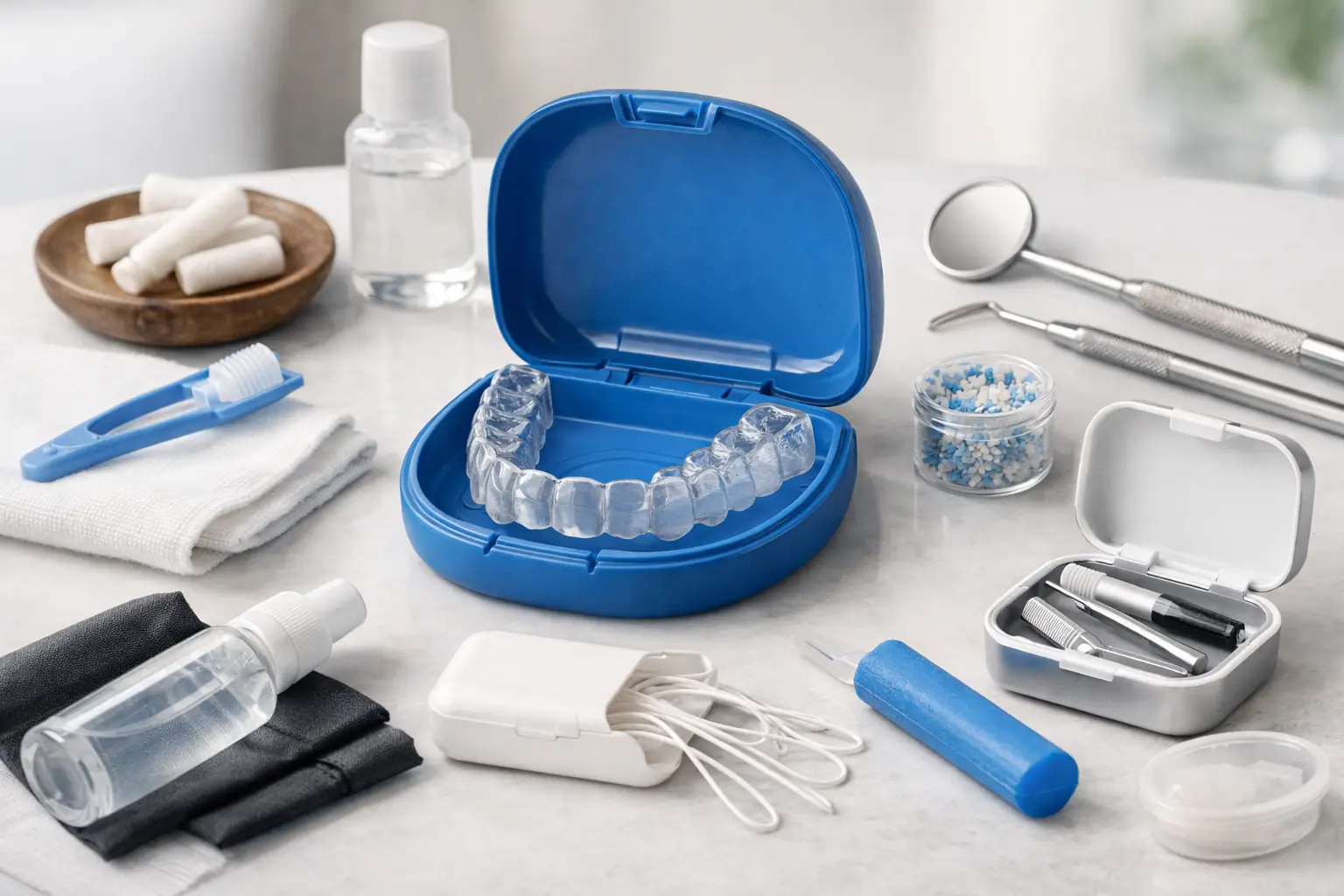

A patient says their trays feel "mostly on," but the occlusal gaps tell a different story. In clear aligner therapy, that small mismatch can slow movement, reduce force expression, and create avoidable refinements. The best accessories for tray seating are the ones that improve fit consistently, support compliance, and strengthen treatment control without adding friction to the workflow.
What makes tray seating accessories worth using
Tray seating is not just a comfort issue. It is a force-delivery issue. If an aligner is not fully adapted to the dentition, programmed tooth movement can lag behind the digital plan. That is when tracking problems begin to compound - especially in cases with attachments, rotations, extrusion mechanics, or heavier staging.
For clinicians, the right accessory does two things at once. It helps the patient seat the tray more effectively at home, and it gives the practice a more predictable path between appointments. That matters because poor seating often presents as a vague complaint at first. Patients may report tightness, difficulty with insertion, or a tray that feels springy. What they are really describing is incomplete engagement.
The best tools are practical, easy to explain, and simple enough to become part of a daily wear routine. If an accessory is too complicated or unpleasant to use, compliance drops. That trade-off matters just as much as the mechanical benefit.
Best accessories for tray seating in real aligner cases
Chewies remain the simplest front-line option
Chewies are still the most familiar tray seating accessory, and for good reason. They are easy to dispense, easy to replace, and easy for patients to understand. By biting repeatedly into a soft cylindrical material, patients can apply distributed pressure that helps the aligner adapt more closely over the teeth.
Their strength is simplicity. For early-stage fit issues, routine seating after insertion, or patients who need a physical cue to fully engage trays, chewies often work well. They are especially useful when the tray appears close to seating but needs additional adaptation around attachments or in the posterior.
The limitation is consistency. Some patients bite lightly and assume they are done. Others overuse them in a way that adds jaw fatigue without improving fit. Chewies also do not solve the underlying biomechanics in more difficult cases. They are a helpful accessory, not a correction strategy on their own.
Aligner seating tools with firmer resistance can improve engagement
Some patients do better with firmer seating aids than standard chewies. These tools can deliver more focused pressure and may improve engagement when a tray feels resistant, particularly during the first day or two of a new stage.
This can be useful in cases with more complex tooth movement, denser attachment patterns, or patients who struggle to seat trays manually. A firmer tool may create a clearer sense of activation for the patient, which can improve confidence and routine use.
That said, firmer is not always better. If the accessory is too rigid or uncomfortable, patients may stop using it. The ideal choice depends on the patient’s tolerance, the design of the movement, and whether seating difficulty is isolated or recurring.
Removal tools matter more than many clinicians expect
A tray that is hard to remove is often a tray that the patient is reluctant to reseat correctly. That is why removal tools belong in this conversation. They do not seat the aligner directly, but they reduce the frustration that interferes with proper wear habits.
Patients with limited dexterity, longer nails, strong retention, or multiple attachments often benefit from a dedicated remover. When removal becomes easier, patients are less likely to distort the tray, skip reinsertion pressure, or shorten wear time because the process feels inconvenient.
In other words, removal and seating are behaviorally linked. If you want better seating compliance, reducing removal friction is a smart move.
Mirror-based fit checks improve patient awareness
One of the most underrated accessories for tray seating is a simple visual aid. Patients often believe a tray is fully seated because it feels close enough. A compact mirror, paired with a clear instruction to check for marginal gaps and attachment engagement, improves self-monitoring.
This works particularly well for adults who want measurable control and for teens who need more structure. It also helps patients understand the difference between expected pressure and incomplete fit. That distinction can prevent unnecessary concern while making true tracking issues easier to identify early.
A mirror is not a mechanical aid, but it improves execution. In many cases, that is exactly what the protocol needs.
Case storage supports cleaner, more consistent reinsertion
Storage cases are often treated like a convenience item, but they play a direct role in tray seating quality. Aligners wrapped in napkins, placed in pockets, or exposed to heat are more likely to warp, collect debris, or get handled roughly. Once tray geometry is compromised, seating predictability declines.
A proper case protects the appliance and reduces the chance of distorted edges that interfere with fit. It also supports better hygiene, which matters because buildup along the inner surface of the aligner can affect adaptation and patient comfort.
For patients who remove trays multiple times a day, this accessory is not optional. It is part of preserving the precision of the appliance between wear cycles.
When seating problems signal the need for more than an accessory
Not every tray seating issue should be managed with a chewable aid or a stronger patient instruction. If the same pattern repeats across stages, or if upper and lower arches are progressing unevenly, the issue may be biomechanical rather than behavioral.
This is where clinicians need to separate temporary insertion resistance from true loss of tracking. If posterior settling is inconsistent, if one arch is advancing while the other lags, or if seating remains poor despite good compliance, adding another simple accessory may not be enough. The problem is not that the patient needs to bite harder. The problem is that force application and timing may need better control.
In these cases, an adjunctive appliance designed to improve aligner seating and synchronize treatment progression can change the trajectory of the case. For practices focused on treatment acceleration and more predictable tracking, this type of integration offers a more advanced solution than disposable seating aids alone.
Why jaw synchronization changes the tray seating conversation
Tray seating is usually discussed at the level of the individual aligner. But in real treatment, upper and lower arch coordination matters just as much. When the arches are not progressing together, fit issues become harder to interpret and harder to manage. A tray may appear not to seat fully because the occlusal relationship is shifting unevenly, not simply because the patient needs a better chewing aid.
That is why a future-focused aligner workflow looks beyond accessories in isolation. It considers whether the patient has the right support for synchronized movement, effective force application, and consistent tray engagement across both arches.
For clinicians who want stronger control without replacing their current aligner system, that is where a solution like SyncSplint fits naturally. It adds a clinically practical layer to improve seating, support upper and lower jaw synchronization, and reduce the delays that often lead to refinements.
How to choose the best tray seating accessory for each patient
The best accessories for tray seating depend on what is actually causing the problem. If the patient is generally compliant and just needs help with initial adaptation, chewies or a firmer seating tool may be enough. If the patient struggles with insertion and removal routines, a remover and storage case may deliver more value than another seating aid.
If awareness is the weak point, visual fit checks can improve consistency quickly. And if the case shows repeated tracking loss, unsynchronized jaw progress, or persistent seating resistance despite good habits, it is time to think beyond accessory-level fixes.
That is the real clinical standard: match the tool to the failure point. Not every patient needs a more complex protocol, but every case benefits from a seating strategy that is intentional rather than generic.
A stronger protocol beats a drawer full of gadgets
The most effective tray seating accessory is the one the patient will actually use, within a protocol the clinician can trust. Sometimes that is a simple chewy. Sometimes it is better storage, better instructions, or better removal support. And sometimes the pattern points to a bigger opportunity - improving treatment control so seating becomes easier because the mechanics are better aligned from the start.
When tray fit improves, force expression improves. When force expression improves, treatment becomes faster, cleaner, and more predictable. That is the standard patients notice, and it is the standard modern aligner practices should build for.

