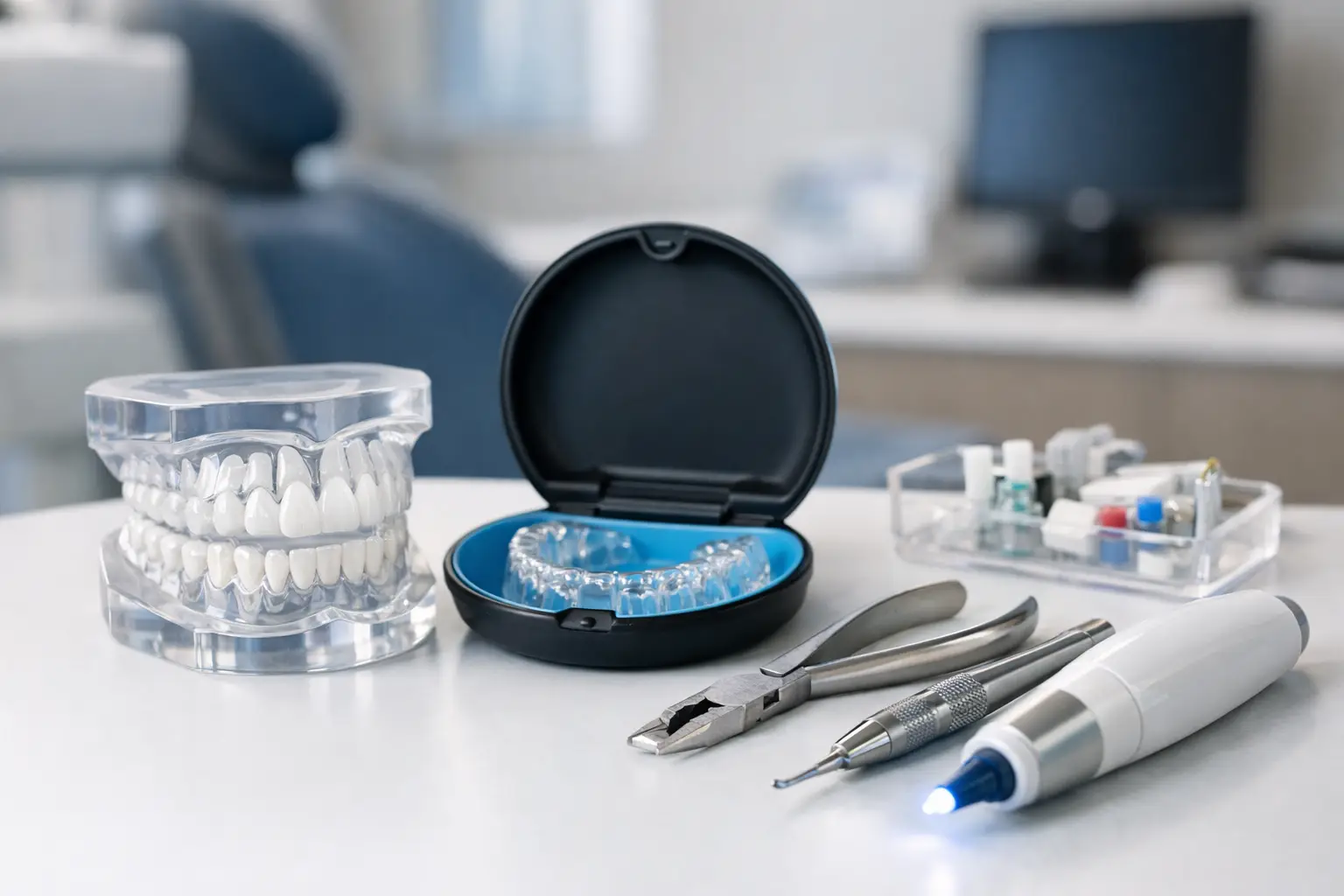

A case looks clean on the digital setup, but by refinement stage the upper arch is lagging, the lower has tracked ahead, and the aligners are fighting for full seating. That gap between plan and biology is exactly where an aligner adjunct for orthodontists becomes clinically valuable. When you need more control without abandoning your current aligner system, the right adjunct can turn a frustrating case into a predictable one.


Why an aligner adjunct for orthodontists matters
Clear aligner therapy has matured, but the core challenge has not changed. Tooth movement is only predictable when force is expressed consistently, aligners seat fully, and both arches progress in sync. When one of those variables breaks down, treatment time expands. Refinements increase. Patient confidence drops. That is why adjunctive appliances are no longer a niche add-on. They are becoming part of a more disciplined aligner protocol. For orthodontists and dentists who want tighter control over biomechanics, an adjunct is not about replacing the aligner system. It is about improving how that system performs in the mouth. The strongest adjuncts solve three problems at once. They improve aligner seating, support more effective force application, and reduce the mismatch that can happen when upper and lower arches do not progress at the same rate. Those are not small gains. They directly affect chairtime, case duration, and how often a treatment plan stays on track without avoidable revisions.What makes the best aligner adjunct for orthodontists
Not every accessory deserves a place in a modern workflow. The best aligner adjunct for orthodontists should fit the way clinicians already practice. If it introduces friction, requires a major protocol change, or only works with one manufacturer, adoption becomes harder than the clinical benefit justifies. Compatibility is the first filter. Most practices are not interested in changing aligner vendors just to gain one extra tool. An adjunct that works alongside major aligner brands has a practical advantage from day one. It protects the clinician's existing workflow, lab relationships, and treatment planning preferences while adding another layer of control. The next filter is clinical impact. A useful adjunct should do more than sound innovative. It should improve tracking in a way the doctor can see and the patient can feel. Better seating means force is delivered more accurately. More accurate force means fewer missed movements and less drift between planned and actual progression. That is where acceleration and predictability start to overlap. Then there is jaw synchronization. This issue is often underestimated until it creates finishing problems. If one arch advances more efficiently than the other, the treatment sequence can become uneven, especially in cases where elastics, bite changes, or complex staging are involved. An adjunct that helps coordinate upper and lower progress adds value beyond simple retention or comfort. It strengthens the entire treatment rhythm.The real clinical payoff: speed with control
Orthodontists do not need faster treatment at the expense of precision. They need speed that holds up clinically. That distinction matters. Some case delays come from biology and patient compliance. Others come from mechanics that are not being expressed effectively. If an aligner is not seating fully, the intended movement is compromised before the patient even leaves the office. Small fit issues become tracking issues. Tracking issues become revisions. Revisions become months. A high-performing adjunct can compress that sequence. By supporting aligner seating and more stable force expression, it helps reduce the mechanical inefficiencies that extend treatment. The result is not speed for marketing purposes. It is speed built on more consistent delivery of the treatment plan. This is especially relevant in practices focused on efficiency. Every extra refinement has a cost. It affects scheduling, team workload, patient communication, and profitability. When a case finishes closer to the original projection, the operational benefit is as important as the clinical one.Where adjuncts create the most value
The value of an adjunct depends on the case, but certain scenarios stand out. Cases with repeated seating difficulty are obvious candidates. So are patients with a history of lagging tracking despite otherwise reasonable compliance. If the aligners are well designed yet performance in the mouth stays inconsistent, additional support may be justified. More complex bite correction cases also benefit from better synchronization. When upper and lower arches need to evolve in a coordinated way, timing becomes critical. If one arch advances and the other stalls, the treatment may still move forward, but not efficiently. That can create finishing challenges that were avoidable earlier in the sequence. Adjuncts can also be useful in practices that treat a broad range of aligner patients, from moderate cosmetic cases to more involved orthodontic corrections. In that setting, a universal enhancement tool is often more valuable than a case-specific workaround. It gives the clinician a repeatable protocol rather than a series of improvised fixes.Integration matters more than novelty
Orthodontic innovation only works when teams can implement it consistently. An adjunct may offer impressive claims, but if it complicates records, confuses patients, or disrupts case acceptance conversations, its real-world value drops fast. This is where product design and workflow integration become decisive. The right appliance should fit into a digital-first practice without creating unnecessary steps. It should be easy to explain, straightforward to prescribe, and simple for patients to use as part of their aligner routine. That practical standard is one reason integrated add-on appliances are gaining traction. They let clinicians keep the aligner platform they know while expanding what that platform can achieve. For practices that want future-ready treatment without rebuilding their systems from scratch, that is a meaningful advantage. One example is SyncSplint, positioned as a universal appliance that works with existing aligner systems to accelerate treatment, improve force application, support jaw synchronization, and make aligners seat more effectively. The strategic value is clear: more control without changing your primary aligner provider.What orthodontists should evaluate before adopting one
The right question is not whether an adjunct sounds promising. The right question is whether it improves predictability in your hands, with your patient base, inside your workflow. Start with compatibility. If the appliance only fits a narrow set of cases or depends on one manufacturing ecosystem, it may limit rather than strengthen your protocol. Broad compatibility supports adoption because the learning curve applies across more of your aligner caseload. Next, look at the claimed benefit and ask how it maps to your most common treatment bottlenecks. If your biggest issue is seating and tracking, choose an adjunct built around those mechanics. If you frequently see asynchrony between arches, prioritize a solution that addresses progression control rather than simply adding another compliance variable. Patient usability also matters. The best clinical design still depends on consistent wear. If an adjunct is hard to understand or cumbersome to incorporate, even motivated patients may struggle. Simplicity drives compliance, and compliance drives outcomes. Finally, consider whether the appliance helps you reduce refinements, shorten active treatment, and finish with fewer compromises. Those are the metrics that matter. Not hype. Not novelty. Measurable control.The future of aligner treatment is layered
Clear aligners are not losing relevance. They are becoming more sophisticated, and so are the tools that support them. The next stage of growth in aligner orthodontics will not come only from better trays or smarter software. It will come from layered treatment systems that improve how those trays perform clinically. That shift is good news for orthodontists. It means you do not have to choose between brand loyalty and treatment advancement. You can preserve the workflows that already serve your practice while adding appliances that improve speed, precision, and consistency. For clinicians who want fewer delays, stronger force control, and more synchronized arch development, the right adjunct is not an accessory. It is a performance tool. And in a field where predictability drives both patient satisfaction and practice growth, performance is the advantage that lasts. The most valuable innovations are the ones that remove friction from treatment while giving doctors more command over the result. If your aligner cases need more than planning alone can deliver, this is where better control starts.