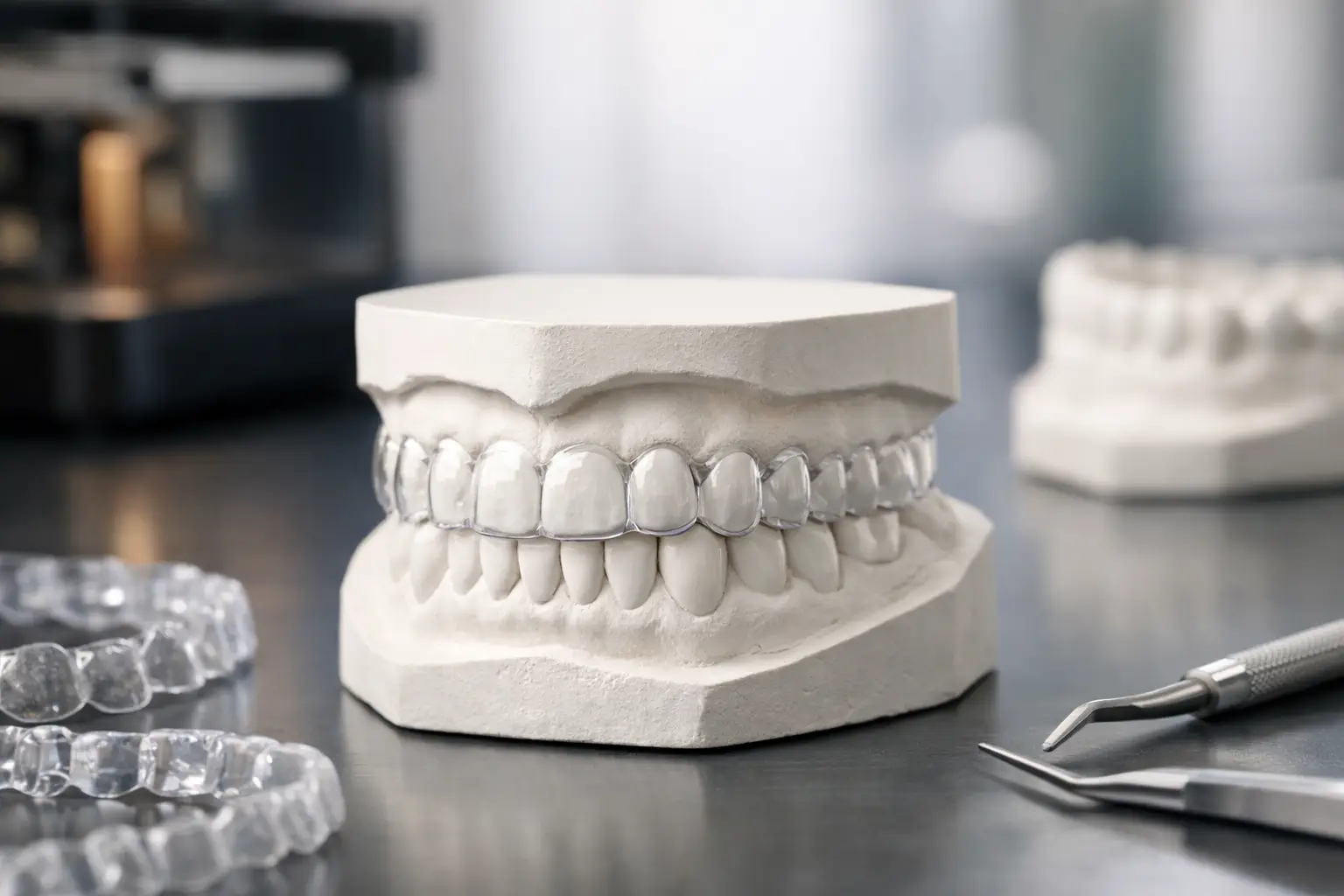

A plaster cast on the bench can still decide whether an aligner case tracks cleanly or starts fighting you by tray three. Plaster model aligner fabrication remains relevant because many practices still receive impressions, maintain legacy workflows, or need a dependable path from physical records to active treatment. The difference is not whether the model is plaster or digital. The difference is how tightly the fabrication process controls accuracy, force delivery, and appliance fit.
For clinicians focused on predictable aligner outcomes, that distinction matters. A well-managed plaster workflow can support strong clinical performance, but it leaves less room for casual handling. Small errors introduced during impression taking, stone pouring, trimming, pressure forming, or model storage can compound into poor seating, attachment mismatch, or tracking loss that shows up later as refinements, chair time, and slower treatment progress.


Why plaster model aligner fabrication still matters
Digital-first orthodontics has changed expectations, but it has not eliminated physical model workflows. Some offices still rely on traditional impressions for selected patients. Some labs continue to fabricate appliances from poured models because the infrastructure is established, reliable, and cost-effective. In mixed workflows, plaster also acts as a bridge when digital files are incomplete, delayed, or unavailable. That said, plaster model aligner fabrication is not just a legacy process to tolerate. In the right hands, it can be a controlled manufacturing method. The key is recognizing that analog workflows demand discipline. Unlike a digital setup, where edits can be made repeatedly before printing or production, errors in stone are harder to reverse without remaking the model. This is where clinical intent has to stay visible throughout the workflow. If the objective is treatment acceleration, precise force application, and predictable seating, the model cannot be treated as a passive replica. It is the physical foundation for every force the aligner will deliver.Where accuracy is won or lost
The first weak point is almost always the impression. Distortion, drag, voids, soft tissue interference, or incomplete capture around gingival margins immediately reduce appliance fidelity. A poor impression does not become more accurate once it is poured. It becomes permanent. Stone selection and pour technique matter next. Expansion behavior, water-to-powder ratio, vibration technique, and setting control all influence dimensional stability. If the model is chalky, abraded, or slightly expanded, the aligner may still form, but the fit will no longer reflect planned tooth positions with enough precision for staged movement. Trimming is another area where efficiency can undermine performance. Aggressive trimming can remove landmarks needed for orientation and adaptation. Inconsistent model bases can also affect how the appliance material is formed or seated during finishing. Practices that treat model prep as routine lab work often miss the fact that aligner fabrication is less forgiving than many conventional appliances. Storage conditions also deserve more attention than they usually get. Plaster is not a neutral medium. Moisture exposure, repeated handling, contamination, and edge chipping all change the working surface. If a model is used for delayed fabrication or remakes, even subtle degradation can alter fit.Fabrication decisions that affect aligner performance
Once a usable plaster model is available, the fabrication stage determines whether the case starts with control or compromise. Material selection, heating consistency, pressure or vacuum forming parameters, cooling time, and trimming precision all influence how closely the aligner adapts to the model. Adaptation is not just about comfort. It is about force expression. An aligner that is slightly lifted at the incisal edge or under-adapted over posterior anatomy will not deliver the same mechanics as one that is fully seated. In mild cases, that may only reduce efficiency. In more active movements, it can change tracking behavior and create the familiar pattern of lagging teeth, incomplete seating, and unplanned refinements. There is also a practical trade-off here. Some fabrication teams bias toward easier insertion and removal. Others prioritize tighter adaptation. Neither extreme is ideal. If the aligner is too passive, it underperforms. If it is excessively tight without a biologically reasonable staging plan, patient compliance often drops and seating becomes inconsistent. Performance comes from calibrated fit, not simply tighter plastic.Plaster workflows and case predictability
Predictability in aligner therapy is not determined by fabrication alone, but fabrication sets the ceiling. A well-designed treatment plan cannot overcome a poorly fitting appliance. Conversely, a precisely fabricated aligner still depends on realistic staging, attachment design, patient wear, and arch coordination. This becomes even more important when upper and lower arches are progressing at different rates. Unsynchronized movement creates downstream issues - compromised intercuspation, uneven seating patterns, and patient frustration when one arch appears to advance while the other lags. In these situations, fabrication quality intersects directly with treatment control. If the appliance fit is already marginal, any discrepancy between arch progression becomes harder to manage. That is why forward-looking practices are moving beyond a narrow view of aligner production. The question is no longer just whether the tray can be made from a plaster model. The question is whether the workflow supports synchronized, efficient tooth movement from start to finish.When plaster model aligner fabrication needs support
There are cases where a conventional fabrication process reaches its limit. Complex movements, repeated seating difficulty, inconsistent tracking, and arch coordination problems often signal that the issue is not simply tray production. The case may need an additional mechanical advantage that standard aligners alone are not delivering. This is where integrated adjunctive appliances become clinically valuable. A universal add-on system that works with existing aligners can improve seating, reinforce force delivery, and help maintain synchronized upper and lower treatment progress without requiring the clinician to abandon the current aligner platform. That approach is especially useful for practices that want more control while preserving their established workflow. For providers using physical models, this matters because the workflow does not need to become digitally pure to become more advanced. Better treatment performance can come from combining disciplined model-based fabrication with appliance strategies designed to accelerate movement and reduce fit-related inefficiencies. That is a more practical path for many offices than rebuilding the entire lab process around a single vendor or technology stack.A stronger workflow for plaster-based cases
If a practice continues to use plaster models, the solution is not to defend the old method. It is to tighten it. Start by treating impressions as production records, not preliminary data. Standardize stone handling and set strict acceptance criteria for model quality. Build consistency into forming parameters rather than relying on technician intuition. Then evaluate every delivered aligner for adaptation, seating, and force expression before it reaches the patient. Clinically, it also helps to identify cases where aligner-only mechanics may be vulnerable from the beginning. Patients with compliance concerns, lagging posterior seating, difficult rotations, or arch synchronization risks benefit from earlier intervention, not later troubleshooting. In those cases, combining precise fabrication with a compatible enhancement appliance can reduce treatment drag and improve predictability. SyncSplint fits naturally into that strategy because it works alongside existing aligner systems rather than replacing them. For clinicians, that means more control over seating and movement efficiency. For patients, it means a treatment experience that feels more decisive and less stalled.The future is not analog versus digital
Too many conversations about fabrication turn into a false choice. Digital is faster to revise and easier to scale. Plaster can still be highly effective when the process is controlled. The real issue is not the medium. It is whether the workflow supports clinical objectives with enough precision to keep treatment moving. For some practices, full digital conversion makes sense. For others, a hybrid model is more realistic and more profitable. It depends on case volume, staffing, lab capability, and how quickly the office needs to move from records to delivery. What should not be negotiable is performance. If a plaster-based workflow is producing inconsistent fit, delayed tracking, or avoidable refinements, the answer is not nostalgia. It is process improvement. Plaster model aligner fabrication still has a place in modern orthodontics, but only when it is handled like a precision system. When impressions are accurate, models are stable, fabrication is disciplined, and treatment mechanics are reinforced where needed, physical workflows can support faster, more predictable aligner care. The smartest practices are not choosing between old and new. They are choosing the method that gives them the most control over results.