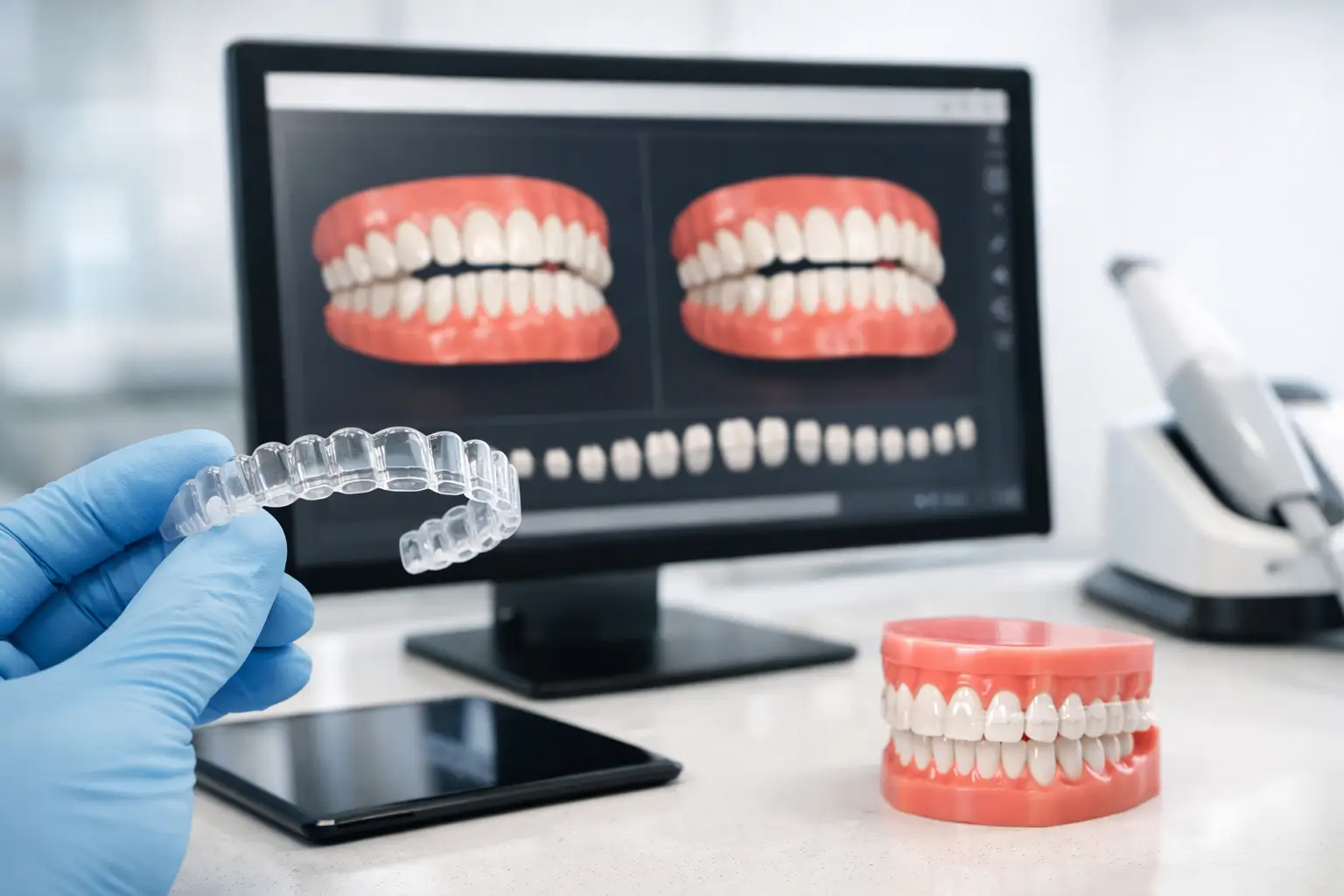

A clear aligner case rarely goes off track because the treatment plan looked weak on screen. It usually slips in the handoff points - attachment delivery, seating issues, arch coordination, patient compliance, or upper and lower progress drifting apart. That is why aligner treatment workflow integration matters. It is not just about adding another appliance. It is about building a protocol that improves control at the exact moments where aligner therapy tends to lose it.
For orthodontists and dentists already delivering aligner treatment, integration only has value if it protects speed, preserves your current system, and improves predictability without creating administrative drag. If a new component forces a different planning ecosystem, disrupts lab relationships, or adds too many chairside steps, adoption stalls. The right approach strengthens the workflow you already run.


What aligner treatment workflow integration actually means
In practical terms, aligner treatment workflow integration is the process of incorporating a complementary appliance, protocol, or tracking method into your existing aligner pathway without replacing your aligner brand, digital setup process, or clinical decision-making framework. The goal is not complexity. The goal is higher treatment performance from the same workflow foundation. That distinction matters. Many clinicians hear “integration” and expect software headaches, retraining, or new case planning rules that slow production. In reality, the best integrated systems behave like a clinical enhancement layer. They fit into the stages you already manage - records, treatment planning, appliance fabrication, delivery, progress checks, and refinement decisions. For clear aligner providers, the biggest integration opportunity is not cosmetic. It sits in force application and treatment synchronization. When upper and lower arches do not progress at the same rate, the consequences show up fast - tracking loss, bite imbalance, compromised seating, delayed refinements, and frustrated patients who feel like they are doing everything right but still not moving on schedule.Where aligner workflows usually break down
Digital planning has improved case visualization, but execution is still biological. Teeth do not always respond with equal speed. Posterior settling does not always cooperate with anterior movement. Some cases show excellent tracking in one arch and lag in the other. If that lag continues across several stages, the treatment plan may still be technically sound while the workflow becomes inefficient. This is where many practices absorb hidden costs. More visits are scheduled to troubleshoot fit. Additional chewies or wear instructions are introduced. Midcourse corrections become more common. Refinement rates climb. None of those steps are catastrophic on their own, but together they extend treatment time and chip away at margin. A second weak point is aligner seating. If the aligner is not fully expressed on the dentition, programmed forces do not translate as intended. Small seating deficiencies can become cumulative. Clinicians then face a familiar question: is the issue poor compliance, poor biomechanics, or poor seating support? Often, it is some combination of all three. A third challenge is that many workflow tools are either too generic or too isolated. They solve one problem but do not connect to the full treatment sequence. A useful integrated system should improve appliance fit, support force delivery, and help maintain coordination between arches. If it only addresses one symptom, the broader case still may not stabilize.A better model for integration in aligner cases
The strongest model is simple: keep the aligner system, improve the mechanics. That gives clinicians the freedom to maintain established vendor relationships while adding a practical advantage where standard aligner therapy can lose efficiency. An integrated auxiliary should work with digital setups, physical models, or aligner-based inputs. It should not require a practice to rebuild how it submits records or how it communicates treatment goals. From an operations standpoint, that is what makes adoption realistic across a busy practice or multi-provider group. Clinically, the value is more specific. Integration works when it helps accelerate tooth movement, increase seating consistency, and synchronize upper and lower arch progress. Those benefits are not marketing extras. They affect the metrics providers care about most - fewer delays, fewer tracking failures, fewer refinements, and better case completion confidence. This is exactly why appliances designed to complement aligner therapy deserve attention. A system like SyncSplint fits this model because it is built to work alongside major aligner brands rather than compete with them. That compatibility matters. It means the clinician keeps the treatment planning ecosystem they trust while adding a layer of mechanical support aimed at faster, more controlled outcomes.How to implement aligner treatment workflow integration without slowing the practice
The first step is selecting the right cases. Not every patient needs the same level of mechanical support, and not every practice has the same pain points. Some teams struggle most with tracking in more difficult movements. Others see frequent lag between upper and lower jaw progression. Others want to reduce total treatment time in a way that is measurable and repeatable. Your integration strategy should start with the problem you are solving most often. Once the use case is clear, integration should follow the existing sequence of care. During records and treatment planning, the clinician identifies whether the case would benefit from an added appliance that supports force application and jaw coordination. At fabrication, the process should accept standard inputs, whether from digital setups, plaster models, or aligner-related records. At delivery, instructions need to be simple enough for staff to reinforce consistently. This is where many integrations succeed or fail. If the team cannot explain the appliance in one or two direct clinical benefits, patient acceptance drops. Patients understand shorter treatment time, better fit, and more predictable progress. They do not need a lecture on mechanics, but they do need confidence that the added step has a clear purpose. At follow-up visits, the integrated workflow should make monitoring easier, not harder. Clinicians should be able to assess seating, tracking, and arch coordination with less guesswork. If a practice already uses digital monitoring or 3D treatment tracking, the added appliance should support those checkpoints by making movement progression more consistent from stage to stage.The trade-offs clinicians should evaluate
Integration is not automatically beneficial just because it sounds advanced. It has to produce a net gain in efficiency and control. That means clinicians should evaluate chairtime, team training, patient instructions, and fabrication turnaround against expected benefits. There is also an important case selection question. High-compliance patients with straightforward movements may already finish efficiently in standard aligner protocols. In those cases, the value of integration may be modest. By contrast, patients with known seating issues, complex occlusal coordination needs, or a strong preference for shorter treatment duration may see much more meaningful benefit. Another variable is provider philosophy. Some clinicians prefer to manage variation reactively through refinements and close monitoring. Others want a more proactive workflow that reduces the likelihood of drift before it appears. Neither approach is irrational, but the second group is usually more receptive to integrated appliances because they are optimizing for predictability earlier in the case.Why integration is becoming a competitive advantage
Patients increasingly compare orthodontic options based on time, convenience, and confidence in results. Providers are judged not only by whether they offer aligners, but by how well they manage cases that do not move perfectly on schedule. That is where workflow design becomes a differentiator. A practice that can maintain its preferred aligner brand while improving movement control has a strategic advantage. It protects existing systems, reduces disruption, and raises performance. For larger groups and internationally active providers, that matters even more. Standardized integration across multiple clinicians can improve consistency without forcing everyone onto a new aligner platform. This is also where future-focused orthodontic care is headed. The market does not need more isolated tools. It needs interoperable enhancements that increase precision inside established workflows. The winning model is compatibility plus control.The real standard for workflow integration
The question is not whether a workflow includes advanced technology. The question is whether that technology changes outcomes in the operatory. If integration improves aligner seating, supports treatment acceleration, and helps coordinate upper and lower progression, it has earned its place. For clinicians, that means fewer compromises between speed and control. For patients, it means treatment that feels more deliberate and less reactive. And for practices looking ahead, the smartest workflow is usually the one that strengthens what already works while fixing what too often fails.